

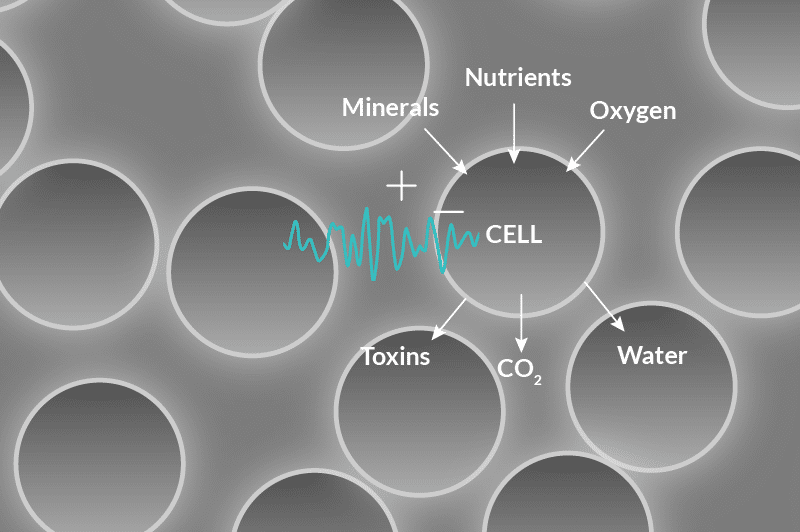
Human bodies are electrochemical organs and can be effectively influenced by low and safe electromagnetic frequencies.
Clustered red blood cells, where surfaces are too dense, is not an optimal situation for oxygen and nutrient delivery.
But specific electomagnetic fields can improve blood cells to be more fluid, thus enabling oxygen and nutrients to circulate effectively.
Mechanisms
It is important to note that electrical and magnetic energy are two forms of energy that are closely interconnected: a moving charge induces electrical and magnetic fields. Electrical current creates a magnetic field, and a magnetic field induces an electrical charge movement. Neurons are electrically active cells. Neuronal oscillations have a dual role in a synapse: they are affected by spiking inputs and, in turn, impact the timing of spike outputs. Because of the above facts, both electrical and magnetic fields may induce electrical currents in neuronal circuits. Therefore, similar mechanisms of altered neuronal activity may underlie different neuromodulation techniques that use electrical, magnetic, or electromagnetic energy in treatment.
According to empirical data, Ca2+and Na+ channel activity can be altered by a static magnetic field and low frequency-pulsed electromagnetic fields. The voltage-gated Ca2+ channels are the primary conduits for the Ca2+ ions that cause a confluence of neurotransmitter-containing vesicles with the presynaptic membrane. The altered activity of Ca2+ and Na+ channel changes the timing and strength of synaptic output, contributing to neuronal excitability.
Another perspective stands that electromagnetic fields increase in adenosine receptors release that facilitates neuronal communication. Because A(2A) adenosine receptors control the release of other neurotransmitters (e.g., glutamate and dopamine), this contributes to adjusting neuronal functions.
According to the natural neurostimulation, energy stimuli induce mitochondrial stress and micro vascular vasodilation. These promote increasing Adenosine triphosphate (ATP) protein and oxygenation, inducing synaptic strength. This position explains neuromodulation from different scale levels: from interpersonal dynamics to nonlocal neuronal coupling. According to natural neurostimulation, the innate natural mechanism of physical interactions between the mother and embryo ensures the balanced development of the embryonic nervous system. The drivers of these interactions, the electromagnetic properties of the mother’s heart, enable brain waves to interact between the mother’s and fetal nervous systems. The electromagnetic and acoustic oscillations of the mother’s heart converge the neuronal activity of both nervous systems in an ensemble, shaping harmony from a cacophony of separate oscillations. These interactions synchronize brain oscillations, influencing neuroplasticity in the fetus. During the mother’s intentional actions with her environment, these interchanges provide hints to the fetus’s nervous system, binding synaptic activity with relevant stimuli. This hypothesis posits that the physiological processes of mitochondrial stress induction (affecting neuronal plasticity) and vasodilation, which cooperatively increase microvascular blood flow and tissue oxygenation, are the basis of the natural neurostimulation. It is also thought to be a foundation of many non-invasive artificial neuromodulation techniques. Because if the mother-fetus interactions allow the child’s nervous system to grow with adequate biological sentience, similar (while scaling) environmental interactions can heal the damaged nervous system in adults.
Molecular mechanisms of biological effects induced by low frequency electromagnetic fields
A recent review summarized the underlying signaling pathways of PEMFs, including Ca2+, Wnt/β-catenin, mitogen-activated protein kinase (MAPK), fibroblast growth factor (FGF), and vascular endothelial growth factor (VEGF), transforming growth factor (TGF)-β/ bone morphogenetic proteins (BMP), insulin-like growth factor (IGF), Notch, and cAMP/protein kinase A (PKA), in bone repair [49]. Furthermore, the mammalian target of rapamycin (mTOR) pathway has also been demonstrated to be the underlying signaling pathway of PEMFs involved in bone formation [50]. Of note, PEMF exposure also affected the synthesis of growth factors such as IGF [51], BMP [52], TGF-β [53], and PGE2 [54], promoting the synthesis of extra-cellular matrix (ECM) proteins and facilitating tissue repair [6].
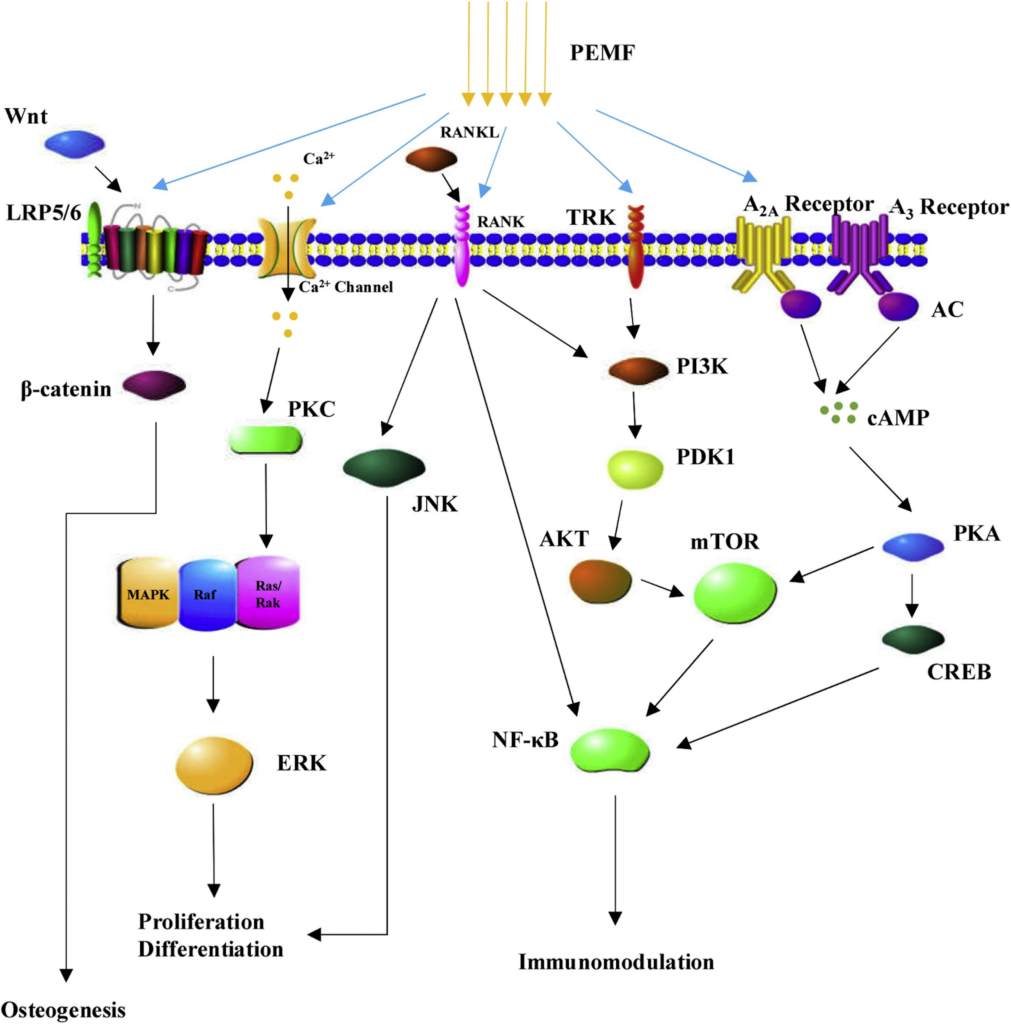
LPEMF stimulation is involved in the regulation of cell proliferation and differentiation as well as immune modulation and inflammation response through a variety of underlying molecular mechanisms.
Summary of abbreviations
PEMF Pulsed electromagnetic field
PKC Protein kinase C
MAPK Mitogen-activated protein kinase
ERK Extracellular signal-regulated kinases
RANKL Receptor activator of nuclear factor kappa-B ligand
RANK Receptor activator of nuclear factor kappa-B
JNK c-Jun N-terminal kinase
PI3K Phosphatidylinositide 3-kinases
PDK1 Phosphoinositide dependent protein kinase-1
AKT Protein kinase B
mTOR mechanistic target of rapamycin
cAMP cyclic adenosine monophosphate
PKA Protein kinase A
CREB cAMP response element-binding protein
NF-KB Nuclear factor-kappa B
What kind of electromagnetic fields does Norra Medicin devices generate?
Low Frequency High Intensity fields are PEMF fields, that are one of electromagnetic field therapeutic modalities, is low frequency fields with specific waveforms and amplitudes, ranging between around zero and 500 Hz [ref]. It is characterized by a high rate of change (Tesla/s) that induces bioelectric currents in tissues, producing special biological effects [ref]. Of note, low frequency fields have been shown to be nonionizing and nonthermal [ref]. The frequency of electromagnetic fields used in clinical treatment is usually less than 100 Hz and the magnetic flux density is between 0.01 m T and 30 mT, while the maximum magnetic flux can range from 0.00001 T to 10 T (depending on home to clinical use)[ref]. The technology applies different types of waveforms including asymmetrical, biphasic, sinusoidal, quasi-rectangular, and trapezoidal [ref, ref]. Among them, quasi-rectangular and quasi-triangular PEMF were approved by FDA as the safe and effective treatment for fractures and their sequelae [ref]. In clinical applications, Bassett’s sawtooth signal is one of the most famous pulsed magnetic field shapes, whose magnetic field changes rapidly. The rapid changes in signal strength can cause large currents in the tissue [ref].More recently, increasing evidence suggests that this noninvasive, safe and effective therapy might be as a promising adjuvant for treating various musculoskeletal disorders [[ref], [ref], [ref], [ref], [ref], [ref]].